
Do We Use Bone In Our Raw Dog Food?
Is there bone in our food? Absolutely! 🦴
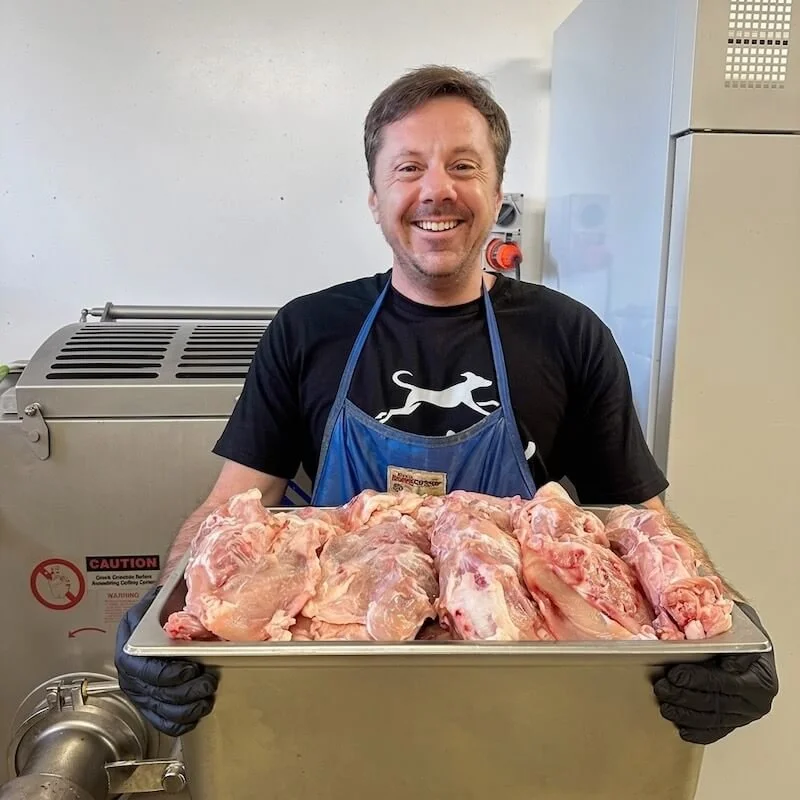
Most of our recipes are made with bone-in organic chicken. These come from Inglewood Organic, Queenslands leading certified organic & free range producer. Their chickens are raised without antibiotics, hormones, pesticides or GMOs.
And importantly they are also grown at nature's pace - taking almost twice as long as conventional chickens to reach maturity. In our opinion easily the best chickens in Queensland!
We use these beautiful chickens and their bone content to balance our food. It's central to how we formulate a nutritionally complete recipe using whole foods only.
In This Article

Why Bone Is Important In The Diet
Bone is more than just a source of calcium. It contains calcium, phosphorus, collagen, magnesium, gelatin and trace minerals, all working together.
Likewise, calcium does more than just build bones. It regulates muscles including the heart, supports immune and endocrine function, and is essential for blood clotting and cellular stability. Every cell in your dog's body depends on it.
Phosphorus is equally important. It supports energy metabolism, cell membrane structure and the body's use of fats and carbohydrates. And critically, phosphorus also regulates the absorption of calcium.
The most important thing to know is that these minerals are co-dependent. You need to feed them together and in the correct ratio for them to be absorbed correctly. Without adequate phosphorus, calcium can't be properly deposited into bone. And without adequate calcium, the body leaches it out of the bones to compensate. Which is not good!
We formulate to NRC nutrient guidelines, targeting around 3000-4000mg of calcium and 2500-3000mg of phosphorus per 1000kcal, giving us an optimal Ca:P ratio of 1.3:1.
Getting this wrong can have pretty serious consequences for your dog. Too little calcium causes skeletal demineralisation, muscle weakness and serious neurological issues. Too much is equally harmful, particularly in large breed puppies where excess calcium interferes with normal bone development entirely.
Our organic chicken bone provides both minerals together in a form the body recognises and absorbs easily. Using these beautiful chicken bones is central to how we formulate our food.
Bone Is Better Than Synthetic Additives
While we use organic chicken bone, most commercial pet food use calcium carbonate as their calcium source. It's mined from limestone quarries, crushed into powder and added during manufacturing. The reason they use it is simple: it's extremely cheap.
The problem is that calcium carbonate is an isolated compound, stripped of the co-factors that make calcium work properly in the body.
Feeding bone does things very differently. Calcium in raw bone exists as hydroxyapatite. This is the form the body recognises and absorbs easily. Bone also delivers collagen, gelatin and cartilage supporting joints, gut lining and connective tissue.
Nature solved this long before pet food manufacturers tried to find a way to cut costs!

What About Our Hypoallergenic Recipe?
Our hypoallergenic recipe Buffalo & Fish doesn't contain chicken. Chicken is a common allergen trigger for sensitive dogs so we keep it out entirely. But we still need a calcium source that won't cause issues for allergy dogs.
We use the leftover eggshells from our Kangaroo & Chicken recipe and turn them into a bioavailable pure calcium powder. Nothing goes to waste! To make it we peel the membrane off the shells, boil to sterilise, bake in the oven to dehydrate, then blitz into a powder. It's a bit of a mission to make but the results speak for themselves.
This only works because we know exactly what's in our food. All ingredients have been nutritionally tested by Symbio Labs in QLD so we know the precise calcium content of the powder and every other ingredient.
It means we can formulate with a high degree of accuracy 🤓

Why This Matters For DIY Feeders
If you're making your dog's food at home, we support you! But please be aware that the most common mistake we see is adding a calcium supplement without understanding the full mineral profile of the recipe. Meat is naturally high in phosphorus and low in calcium, and different meats have very different profiles. Adding calcium powder without accounting for this will likely make things worse, not better.
The effects are cumulative too. It can take months or even years for symptoms to show up, and by the time they do the damage can be hard to reverse. This is especially true for puppies.
If you want to make your own food, I strongly suggest working with a qualified canine nutritionist. It's not a massive outlay to get a diet developed specifically for your dog using the ingredients you have available. I no longer have time to consult but am happy to point you in the right direction, just get in touch.
Alternatively, use a properly formulated recipe. Steve Brown's “Unlocking the Canine Ancestral Diet” is in my opinion the best resource out there. Avoid random internet recipes, most are not properly formulated.
Whatever you use, make sure it meets NRC nutrient guidelines!
Of course, if you'd rather leave it to us, we've got you covered! Every Whoa Nelly! recipe is precisely formulated, lab tested and made with the most amazing ingredients from SEQ. We make food so delicious your dog won't know how good it is for them 🐾